Date & weather
- Date: 2026-05-09, mid-afternoon.
- Temp: mid-60s°F.
- Wind: light — enough to flag the cottonwoods, not enough to make working frames a problem.
- What's blooming: dandelions are running the show. The whole back pasture in Weston is yellow with them, the fruit trees are about done dropping petals, and the alfalfa is still weeks off.
This was supposed to be the big frame-by-frame inspection I'd lined up for the first weekend of May in the last entry. It kept getting pushed — wind one day, work the next, life — and by the time I actually got out there with a couple of free hours, all I had time for was a quick look into two of the four hives. So this is not the methodical, take-a-Varroa-baseline, swap-the-top-boxes inspection I'd planned. It's the "I have ninety minutes, let me at least confirm everyone has a queen" version. Which is just as well, because the first hive I opened doesn't.
Entrance check
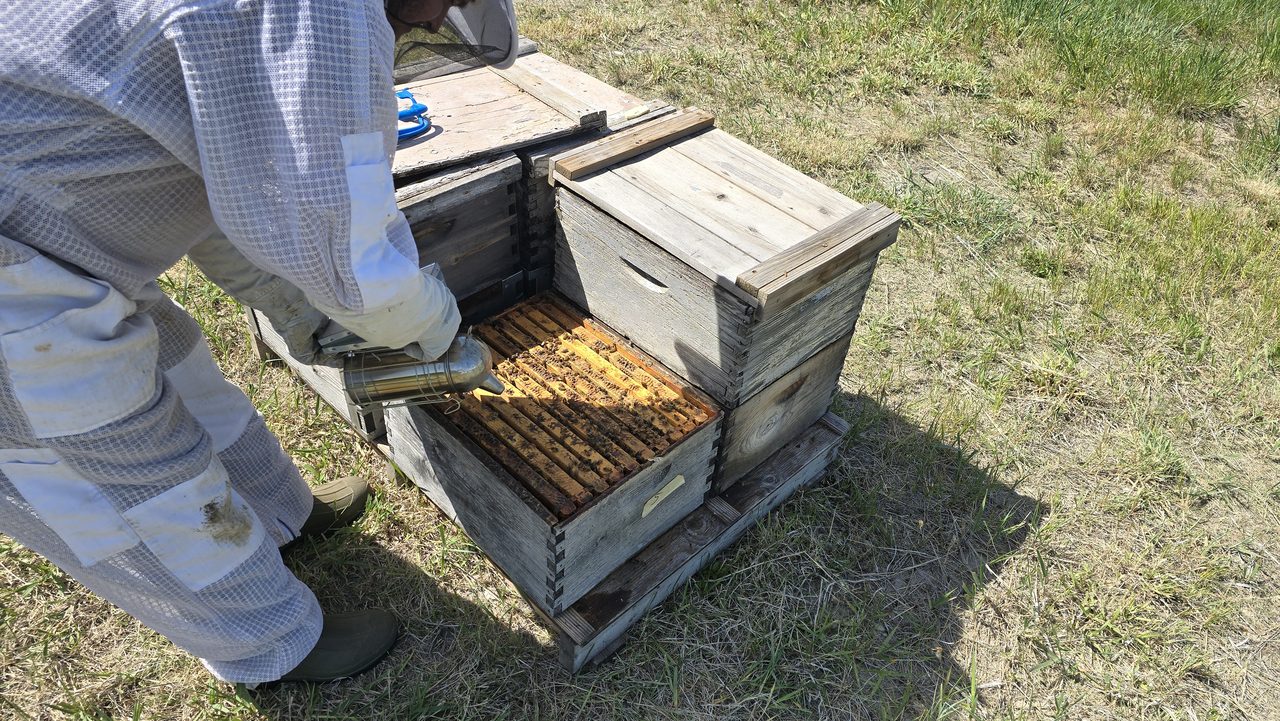
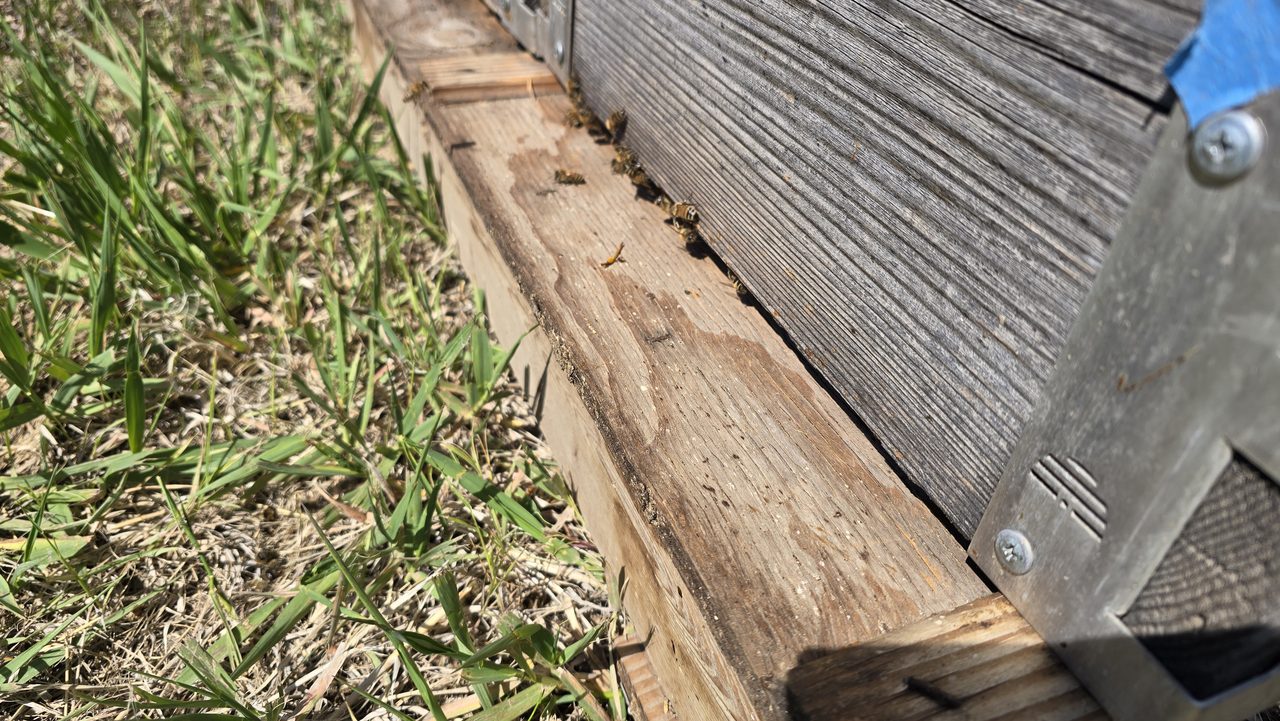
I always stand and watch the fronts for a minute before I crack anything. Hive 3 (one of the new Italian-cross colonies from the second pickup) had the traffic you want to see on a warm afternoon in the dandelion flow — a steady stream in and out, a fair number of bees landing heavy with pollen. Hive 2 (the slower of the original Carniolan-cross pair) was quieter. Not dead-quiet, but a trickle where I expected a stream. In hindsight that was the first hint, and I should have weighted it more than I did. A hive that's lost its queen doesn't shut down overnight, but the population starts coasting downhill, and you can read some of that off the landing board before you ever pick up the hive tool.
Hive 2: the one I'm worried about
I opened Hive 2 first. Decent cluster of bees — not booming, but a respectable number of frames covered. Then I started actually reading the comb, and the picture got bad fast:
- Capped brood: a few scattered patches, and not much of it. Older capped brood — the kind that's going to emerge over the next week and not be replaced by anything.
- Larvae: none I could find. Not "a little." None.
- Eggs: none. I tipped frames toward the sun, looked down into the cells at the angle where you can pick out eggs against the white wax, went through the brood-nest frames twice. Nothing.
- Queen: didn't spot her — but I also didn't tear the box completely apart looking, because by that point the brood pattern had already told me what I needed to know.
No eggs means no laying queen for at least three days. No young larvae means at least eight or nine. A brood nest that's down to a few patches of older capped brood means this has been going on a couple of weeks. Best guess: they superseded a failing queen and the replacement didn't mate successfully, or didn't make it back from her mating flight, or there was a swarm I didn't catch and the cast left without a viable queen behind. I can't tell you which from one quick look. What I can tell you is there is no functioning queen in that box right now, and the colony is on a clock — without new brood, the population just bleeds down until there aren't enough bees to do anything about it.
Hive 3: queenright and humming
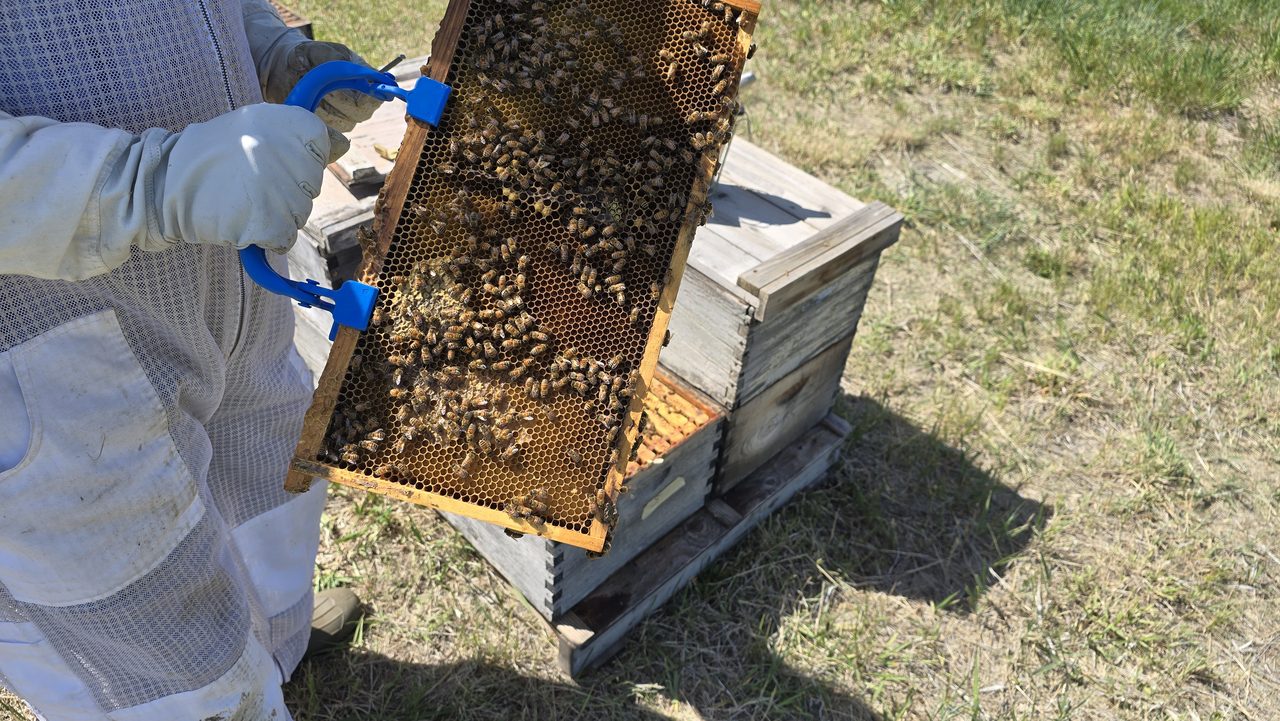
Then I opened Hive 3, and it was the exact opposite story. Three or four frames carrying open brood — eggs, every larval stage, capped brood in a tight pattern — plus the usual arc of pollen and nectar around the edges. I didn't lay eyes on the queen here either, but I didn't need to: eggs standing up in the bottom of the cells means she was in that box within the last day or two and laying well. Strong, healthy, building exactly the way an Italian-cross colony off post-almond stock should be building in a Cache Valley dandelion flow.
So I had a queenless hive sitting three feet from a hive with eggs to spare. That's about the easiest version of this problem a beekeeper can be handed.
What I did: borrowed a frame of eggs
I pulled one frame out of Hive 3 — the one with the freshest-looking eggs and the youngest larvae I could find — checked both sides carefully to make sure the queen wasn't riding on it, and moved it straight into the middle of Hive 2's brood nest, bees and all. Since Hive 2 is queenless, I didn't bother shaking the Hive 3 nurse bees off; a queenless colony will take them without a fight, and the extra nurses are a bonus. Closed both hives back up. Whole thing took maybe ten minutes.
That one frame does two jobs:
- It's the fix. A queenless colony with no other options will raise an emergency queen off young worker larvae. Give them a frame with eggs and day-old larvae and the right-aged nurse bees to feed royal jelly, and they'll start drawing queen cells on it within a day. Three weeks or so after that — if she mates well — Hive 2 has a laying queen again, and it cost me one frame.
- It's the diagnostic. If I come back and find queen cells drawn on that frame, it confirms Hive 2 is genuinely queenless. If I come back and find no cells, that tells me there's probably a virgin queen already in there — recently emerged, not laying yet — and the colony knows it. Either way, the frame answers the question I couldn't answer by eye.
One thing I'm not doing yet is the top-brood-box swap I floated in the last entry — lifting Hive 1's crowded top deep onto a slower hive. You don't dump a box of brood and bees into a colony until you know it has a working queen to hold it together. That idea is parked until Hive 2's queen situation resolves one way or the other.
First burn on a hand-me-down smoker
Side note that turned into a small lesson: this was the first time I've actually run a smoker on my own bees. Every move so far has been after sunset in the upper 40s, when the cluster's calm and a veil is overkill, let alone smoke. A 65° afternoon with the colonies flying is a different animal, so out came the smoker.
It's a hand-me-down. Dad gave it to me because he has a couple and likes the other one better, which — having now used this one — I get. I had trouble keeping it lit, kept getting a lazy flame licking up out of the top instead of the cool, steady white smoke you actually want. That's mostly operator error on a smoker I don't know yet: too little fuel packed in, not enough packed down on top to choke the flame, and probably too small a firebox to hold a burn while I'm head-down in a hive for twenty minutes. I babied it through the inspection, but I spent more attention on the smoker than I'd like to.
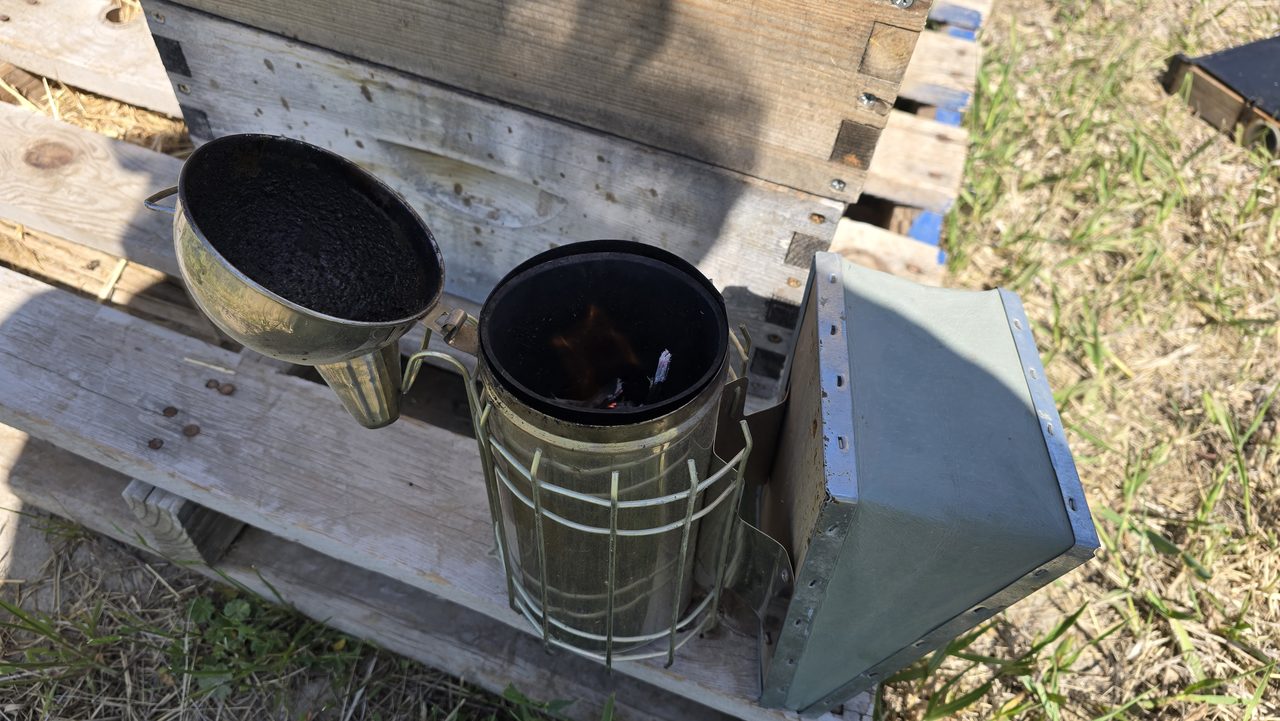
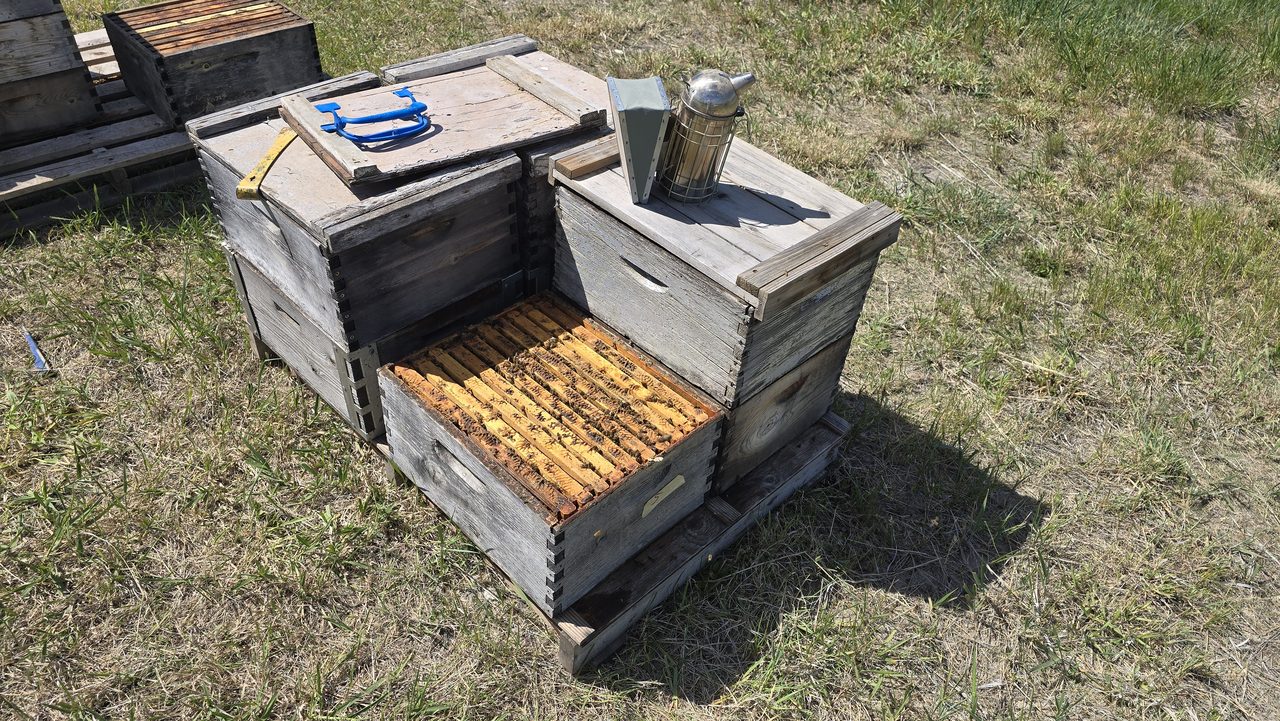
So a new smoker is going on the list. I'll write up what I land on once I've actually used it — I'd rather recommend gear I've run through a season than gear I've read about. If you're outfitting now, the smoker section of the recommended gear page is the short version of what I'd tell a friend.
A drone, up close
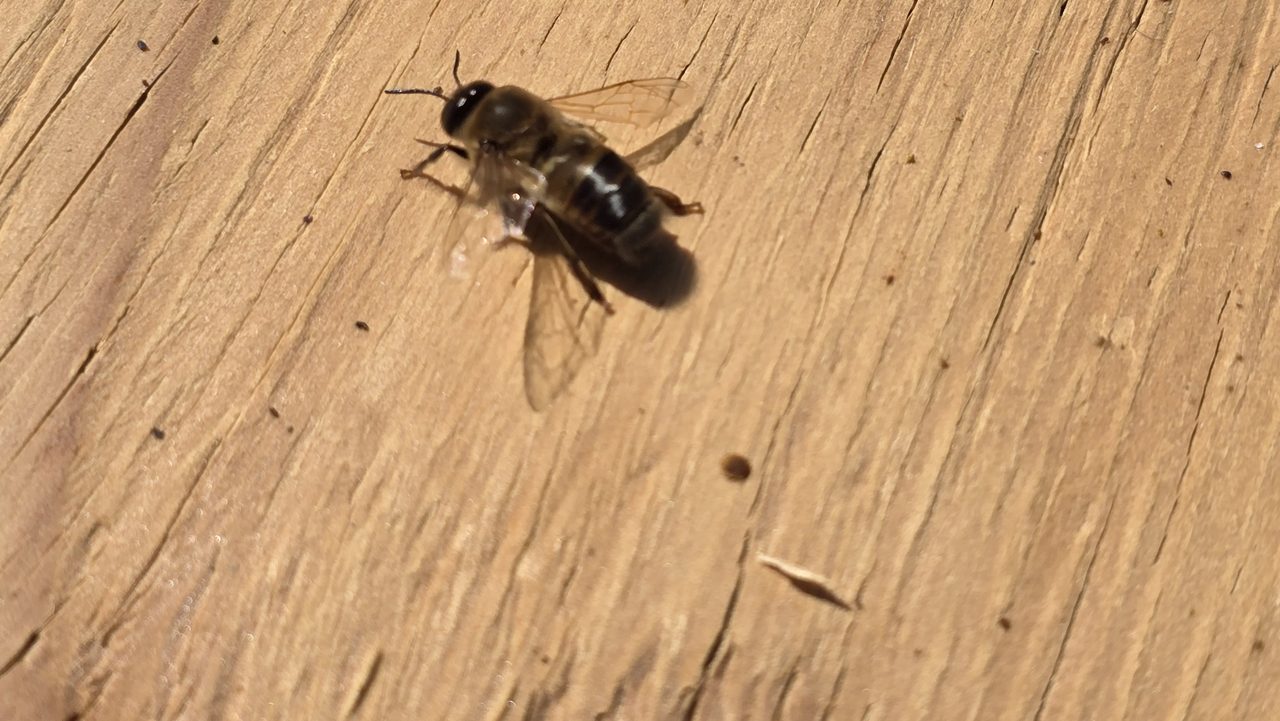
While I had a hive open I grabbed a close-up of a drone walking across a top bar — the wide wraparound eyes that meet at the top of the head, the blunt fat abdomen, the heavier body. Drones being out in numbers is its own little calendar marker: a colony only bothers raising and feeding a bunch of freeloading males when it's strong enough to think about reproducing, which in this valley means swarm season is on. Worth keeping in the back of my mind for Hive 1, which was already pushing the top deep wall-to-wall at the end of April.
The other two are this week's problem
I never got the lids off Hive 1 or Hive 4. That's a problem, because I'm leaving for about a week, and I'd rather not go into that trip with two of four colonies unchecked — especially when one of the two I did check turned out to be queenless. Hive 1 is the crowded Carniolan-cross that's a swarm risk if it gets ignored for ten days in May; Hive 4 is the other new Italian-cross colony and should be in good shape, but "should be" is exactly the phrase that bit me on Hive 2.
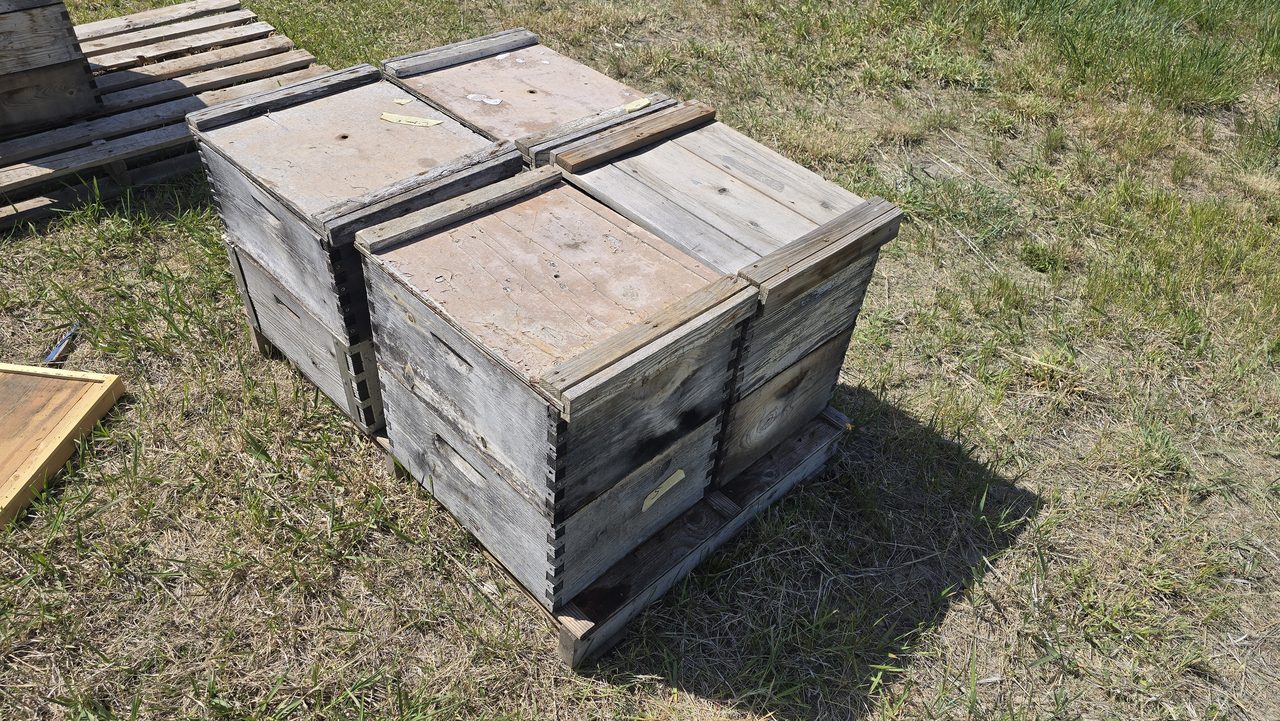
So before I go, the plan is one more short trip: pop Hive 1 and Hive 4, confirm queens and brood, give Hive 1 space if it needs it (another box, or pull a couple of frames of brood to relieve the pressure), and — if I have a minute — finally take that Varroa baseline I keep writing "I'll do it next time" about. As for Hive 2, the egg frame I gave it doesn't need me for a week. Emergency queen cells take roughly sixteen days from egg to a virgin emerging, so a week unattended is actually fine — I'll come home to capped cells (good) or no cells (telling), and decide then whether to let her mate out naturally or just buy a mated queen and be done with it. Honestly, leaving a queenless hive alone for a week right after diagnosing it feels wrong in my gut, but the math says the frame buys more time than I'll be gone.
What I'd do differently
Two things. First: I should have done this inspection two weekends ago, when I'd planned to. If I'd caught Hive 2 at the start of May instead of the second week, I'd have had more runway — more time for an emergency queen to mate before the dandelion flow tapers, and the option of combining it with another colony while it still had a useful population. A two-week delay on a queen problem isn't fatal here, but it spends margin I didn't need to spend. The lesson I keep relearning: in this valley the spring window is narrow, and "I'll get to it next weekend" is how you find out a hive's been queenless for three weeks instead of one.
Second, smaller: I let the smoker eat my attention during the inspection. A tool you can't keep lit without babysitting is a tool that's pulling focus off the bees. Either learn to run this one properly or replace it — and I think I already know which way that's going.
What's next
- Before I leave: a short trip to check Hive 1 and Hive 4 — queens, brood, swarm space on Hive 1, and a Varroa baseline if I can swing it.
- When I'm back (about a week out): re-open Hive 2. Queen cells on the donor frame = let her finish and watch for her to start laying; no cells = there's a virgin in there, give it more time; if it's gone backwards, combine it or drop in a bought mated queen.
- Keep an eye on Hive 1 for swarm cells — drones are flying, the top deep was packed, and that's the recipe.
- Run the smoker some more, or pick a better one. Either way I'll write up the verdict.
Related
- All entries in this series
- The previous entry — four hives on pallets, and the inspection plan that slipped
- Spring inspection checklist for Cache Valley — what to look for on the frames, including the egg-and-larvae check that flagged this
- Cache Valley bee forage guide — what the dandelion flow is and when it tapers
- Recommended gear — including smokers, for when the hand-me-down isn't cutting it
Product links above go to Amazon.com. As an Amazon Associate I earn from qualifying purchases.